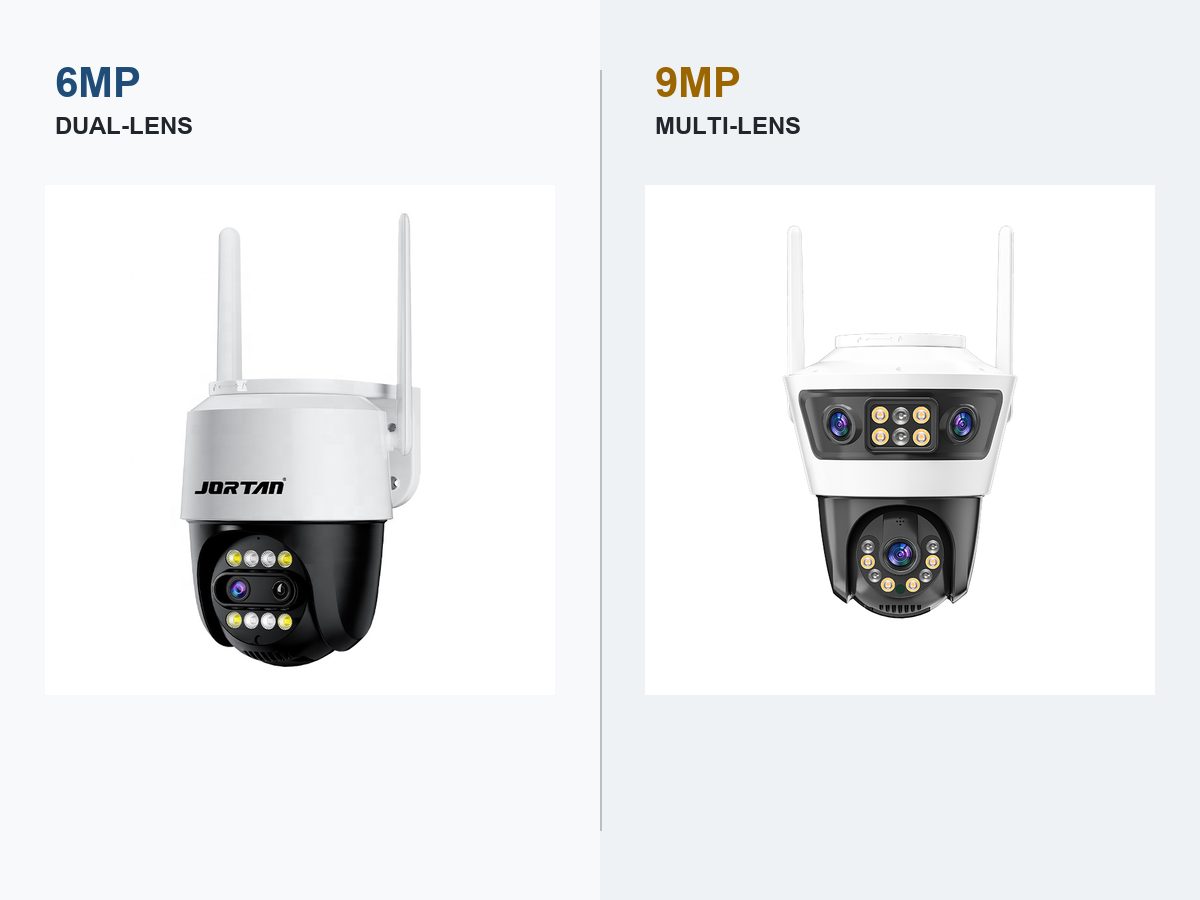
Warehouses, parking areas, and construction sites are not going to offer a single perspective to be viewed. A loading dock could require constant surveillance through one channel, while another one tracks any movement close to the parked cars or the stacked merchandise. Multi-lens cameras are gaining popularity in such outdoor applications. The carton box may still mislead. A 9 megapixel surveillance camera would split these megapixels into three video channels, whereas a 6 megapixel surveillance camera would have two 3 megapixel sensors.
More Megapixels Change Coverage Before They Change Detail
For a multi-lens security camera, the first question is not simply “6MP or 9MP?” It is how the total is built. A 6MP dual-sensor model commonly produces two 3MP views. One documented Jortan configuration outputs 2048 x 1536 on each of two channels. A 9MP three-lens layout may use three 2048 x 1536 channels. In both cases, the buyer is often comparing the number of simultaneous views as much as the detail within one frame.
That distinction matters during project acceptance. If a client expects one 9MP image that can be enlarged heavily, three separate 3MP streams may not meet that expectation. If the job needs a gate, driveway, and PTZ close-up visible at the same time, however, three streams can be more useful than one high-resolution fixed image. Clarity must be tied to the target, distance, lighting, and playback task.
Lens Layout Decides What the Operator Can See
Fixed Overview Plus PTZ Close-Up
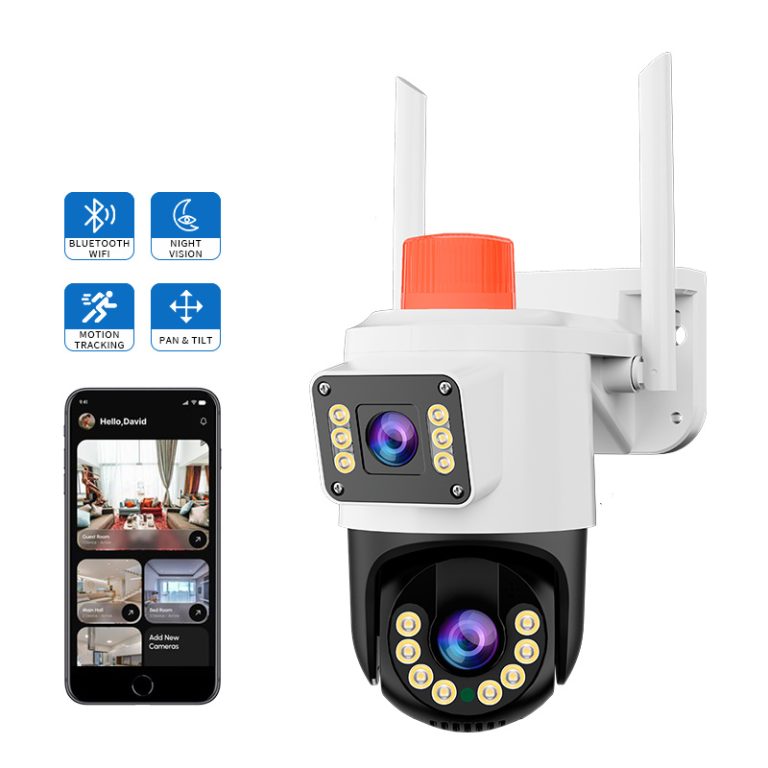
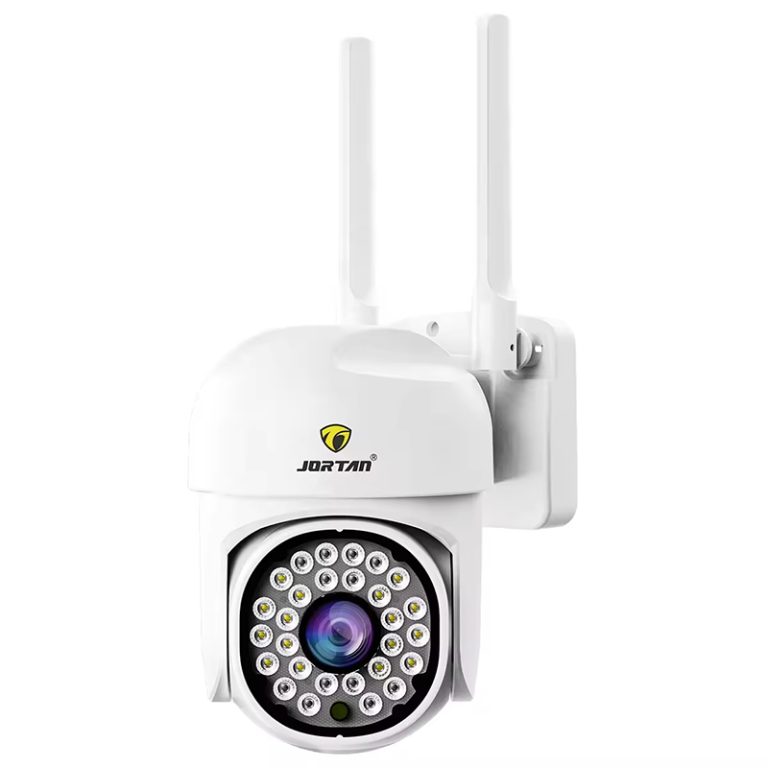
A practical dual-lens arrangement pairs a fixed overview lens with a rotating PTZ module. The wide view keeps the main lane visible while the PTZ view follows movement, so a warehouse loading bay does not disappear when an operator checks a target.
The arrangement can replace two housings and network connections, but the bracket must be rigid and both lenses need an unobstructed angle. A loose wall surface or exposed cable entry can lead to repeated site visits.
Dual-Channel Versus Three-Channel Viewing
Two channels are usually enough when the project has one priority zone and one wider reference view. Three channels become useful when the camera must divide a broad facade, parking row, or yard into more than two active areas. A 9MP model with three 3MP sensors may therefore look more complete on a multi-view app screen without producing a sharper single channel than a 6MP model with two 3MP sensors.
Ask to see live multi-view, recorded playback, and the transition between fixed and PTZ views. A smooth preview is not enough if installers cannot retrieve the correct channel later.
Four Specifications Shape Real Image Quality
Per-Stream Resolution, Sensor, and Lens
Per-stream resolution should appear on the order sheet. Jortan’s documented 6MP setup uses two 1/3-inch SC2336 sensors, while a 9MP setup uses three 1/2.8-inch low-light CMOS sensors. Sensor format affects how each channel performs under difficult lighting.
Lens choice changes the answer just as much. A 2.8mm lens gives a wider view for a short warehouse aisle or broad entrance, while a 12mm lens narrows the scene and brings a more distant target closer. Hybrid zoom can help frame an incident, yet enlarged digital detail cannot replace a suitable focal length. Jortan offers fixed, PTZ, dual-lens, and outdoor wireless formats, so buyers can match the optical layout to the site rather than treating pixel count as the only selection rule.
Bitrate, Frame Rate, and Night Conditions
Low bitrate, aggressive compression, or weak WiFi may smear moving edges even when a still frame looks acceptable. One 6MP setup supports H.265, 0.1 to 10Mbps streams, and 1 to 30fps. A 9MP setup may run at 12 or 15fps, depending on the platform.
Night tests should include wet pavement, white vehicle panels, safety jackets, and warehouse lamps. Noise reduction, WDR, IR-CUT, infrared mode, and full-color lighting help, but poor lamp placement may wash out a nearby face. A bright showroom video is not a field test.
Match the Camera to the Site, Not the Carton
Warehouses and Loading Areas
Inside a warehouse, two coordinated views can cover a loading door and its approach lane. Human-shape tracking follows movement while the fixed channel keeps forklifts and pallets in context. A Jortan dual-sensor setup supports alerts, WDR, H.265, TF storage up to 256GB, cloud storage, and ONVIF.
Measure WiFi at the final mounting point with doors closed and nearby equipment running. Metal shelving can weaken the signal, and dropped playback frames cancel any benefit from a higher pixel label.
Parking Areas and Exposed Outdoor Sites
Parking areas benefit from wider scene division. A three-lens model can keep two directions visible while the PTZ view follows movement. Buyers comparing outdoor WiFi camera options should check the network path, night reflections, mounting height, water sealing, surge protection, and useful detail at the actual distance.
Batch consistency matters. Changes to bracket thickness, antenna position, cable length, or lamp-board layout can force drilling changes or create blind areas across many sites.
Where Jortan 6MP and 9MP Models Fit
A 6MP Dual-Lens Setup for Two Priority Views
The Jortan3 6MP dual-lens camera pairs two 3MP channels with 8x zoom, outdoor WiFi PTZ movement, IR-CUT, and full-color night imaging. It fits warehouses, compact parking entrances, shops, and yards needing one overview plus one movable detail view.
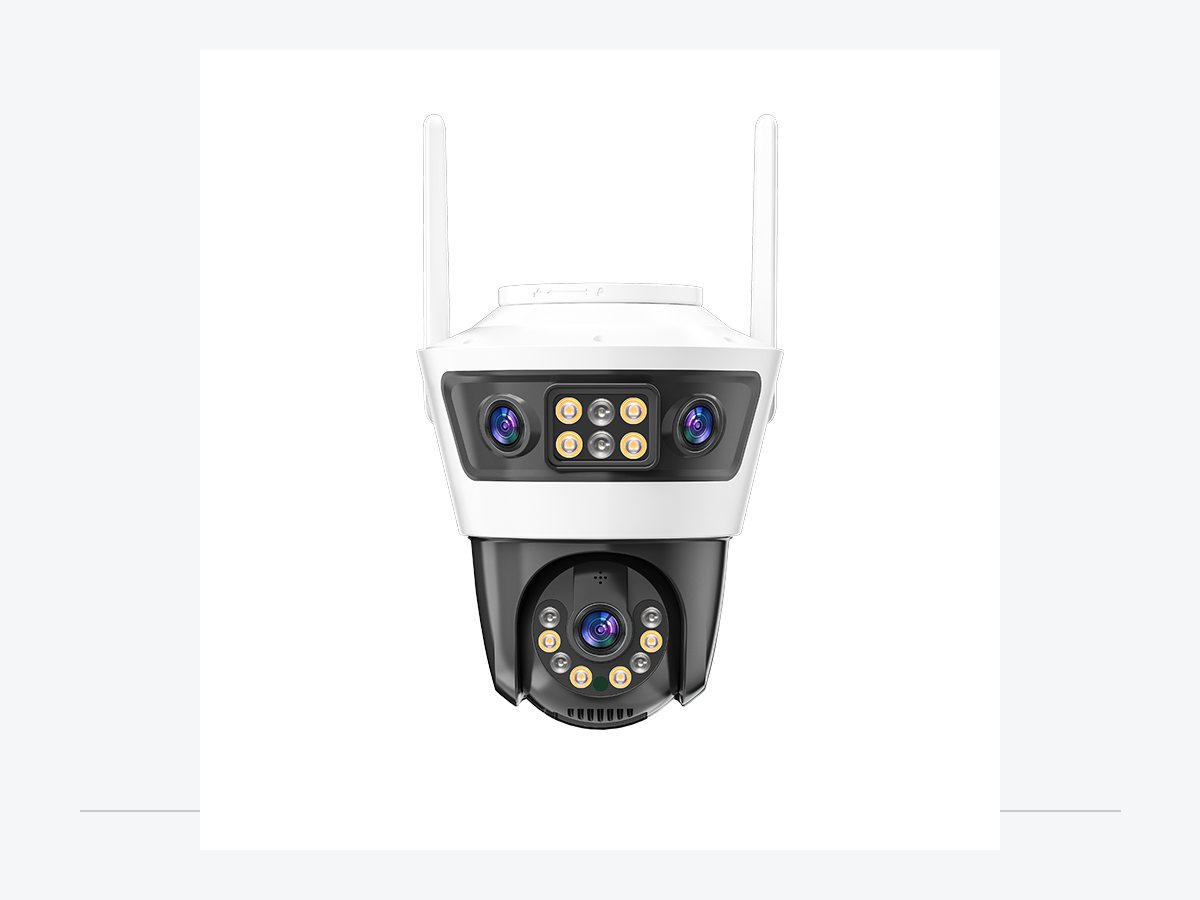
Its value comes from the two-view layout and lens pairing, not the label alone. Record the app, sensor, codec, frame rate, storage limit, antenna, and bracket during sample approval so the shipment can be checked against it.
A 9MP Multi-Lens Setup for Wider Scene Division
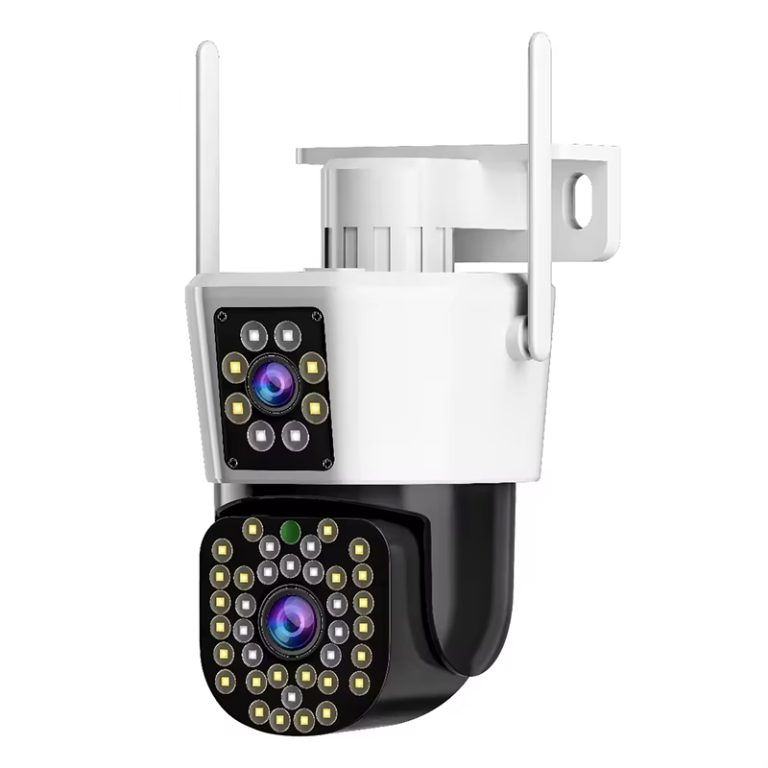
The Jortan6 9MP multi-lens camera uses three 3MP sensors with a 2048 x 1536 x 3 array, recognition for people and vehicles, MicroSD storage up to 128GB, two fixed views, and one rotating view. It fits parking rows, warehouse exteriors, courtyards, and larger entrances.
Configuration details vary across 9MP platforms. One option lists H.265AI, 2.8mm and 12mm lenses, 8x hybrid zoom, 12fps, WiFi, and RJ45. Another uses Smart H.264 at 15fps. Lock the sensor count, codec, frame rate, app, storage, lenses, and network interface before production.
Test Samples the Way the Cameras Will Be Used
Place both samples at the same height and distance. Record a person walking, a vehicle entering, and a static target with small print in daylight, backlight, infrared, and full-color night modes. Compare exported recordings channel by channel.
Restart the router, reconnect the app, fill the memory card, switch between live and playback views, and check whether alerts identify the correct channel. Confirm bracket hardware, sealing parts, power supply, manuals, spare accessories, and firmware support. Missing items or a changed app build can create more returns than a modest pixel difference.
For branded programs, document OEM and ODM configuration with a signed sample record. Logo position, carton artwork, app choice, voice language, accessories, and production settings should be frozen together. Otherwise, a distributor may receive visually similar cameras that behave differently from the approved sample.
Final Recommendation for Outdoor Projects
Choose the lens architecture first. A 6MP dual-lens model is often sufficient when two coordinated views cover the site and the PTZ channel has the right focal reach. A 9MP security camera makes more sense when three simultaneous views reduce blind areas or replace additional housings. Neither label guarantees better evidence by itself.
The final decision should come from per-stream resolution, sensor and lens pairing, moving-detail tests, night performance, network stability, app playback, and repeatable production settings. Buyers planning a warehouse, parking area, or outdoor installation can contact Jortan with the site layout, viewing distances, and required channels to prepare a focused sample plan.
FAQ
Q1: Is a 9MP security camera always clearer than a 6MP camera?
A1: No. A 9MP label may represent three 3MP channels, while a 6MP model may provide two 3MP channels. Compare each stream, focal length, bitrate, frame rate, and night recording at the required distance.
Q2: Which multi-lens layout is better for warehouses and parking areas?
A2: Two views usually fit a warehouse door, aisle, or compact entrance. Three views are useful for wider parking rows or outdoor facades where several directions must remain visible while the PTZ lens follows movement.
Q3: What should buyers confirm before ordering customized Jortan cameras?
A3: Freeze the sensor count, per-stream resolution, lens combination, codec, frame rate, app, storage, network interface, bracket, accessories, packaging, and firmware version against the approved sample.