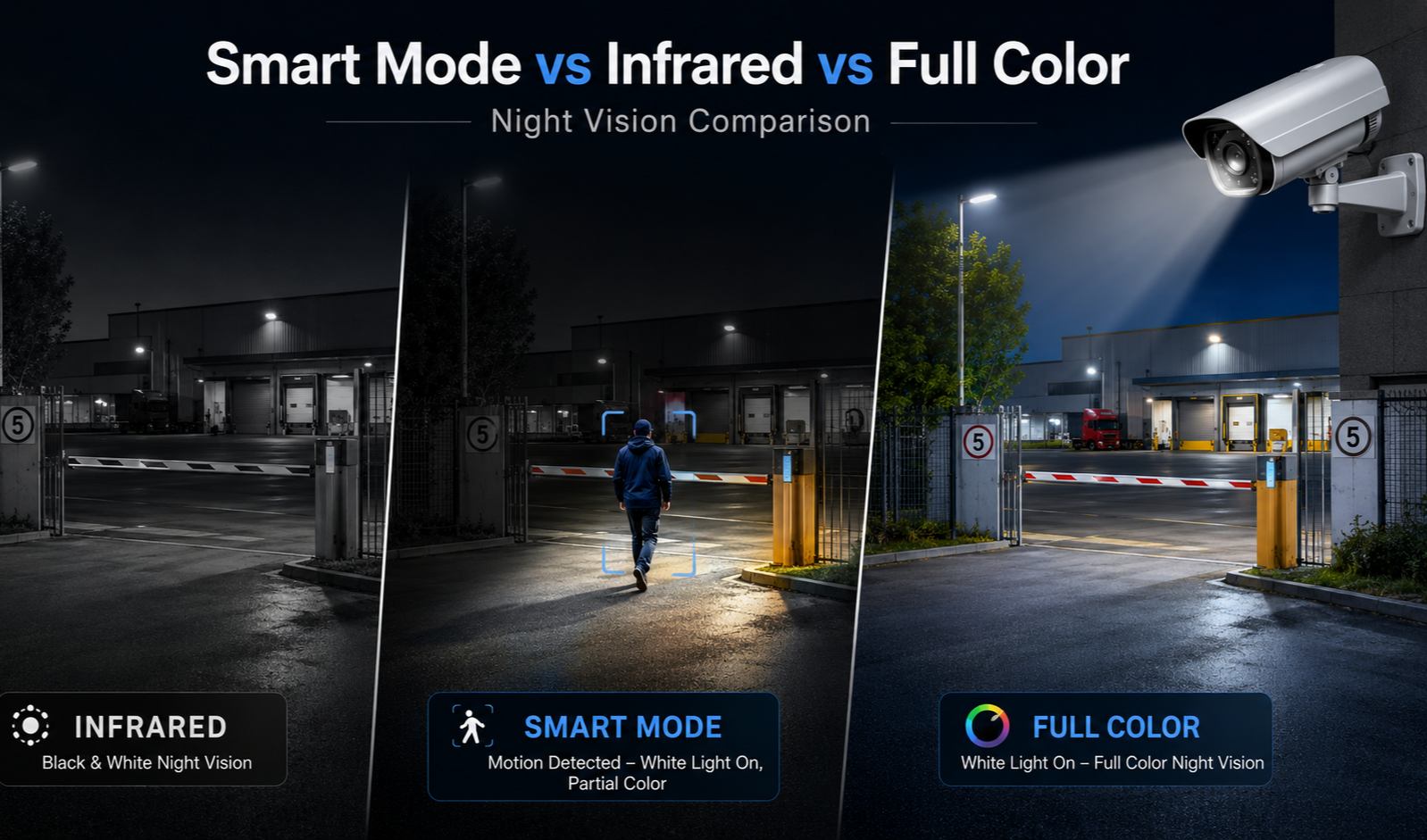
Night vision is easy to oversimplify in product selection. Many buyers only ask whether a camera “has night vision,” but the real difference lies in how the camera handles darkness: staying in infrared black-and-white, turning on white light for full color, or switching modes only when movement appears. For B2B projects, that choice affects image detail, light disturbance, power use, warning effect, and after-sales feedback.
What Each Mode Is Really Doing at Night
Smart Mode Is a Night Strategy, Not Just a Feature Name
In practice, smart mode usually means the camera can switch between infrared, white light, and alarm logic depending on the scene. That mixed logic matters when the customer wants flexibility without touching settings every night.
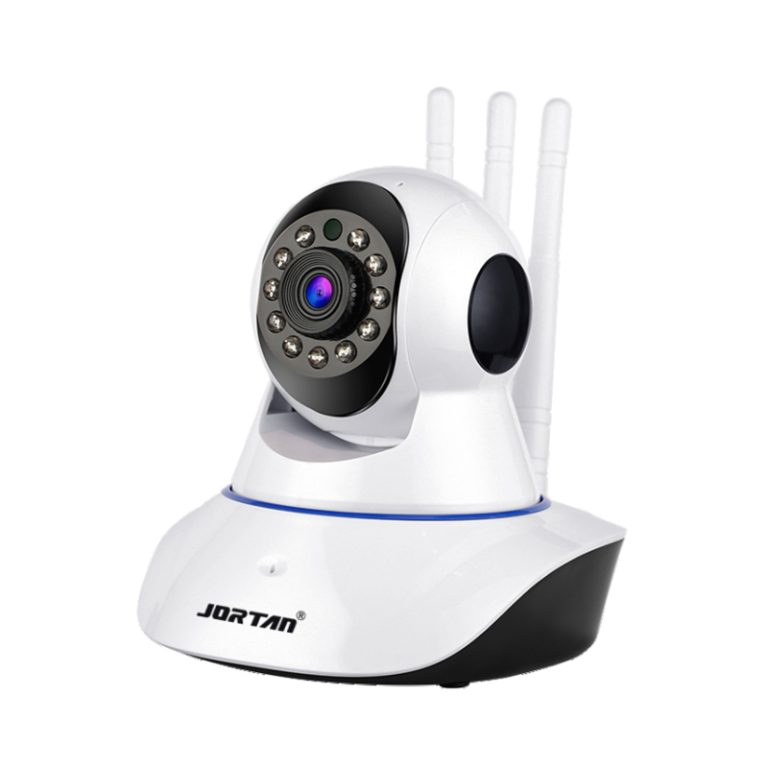
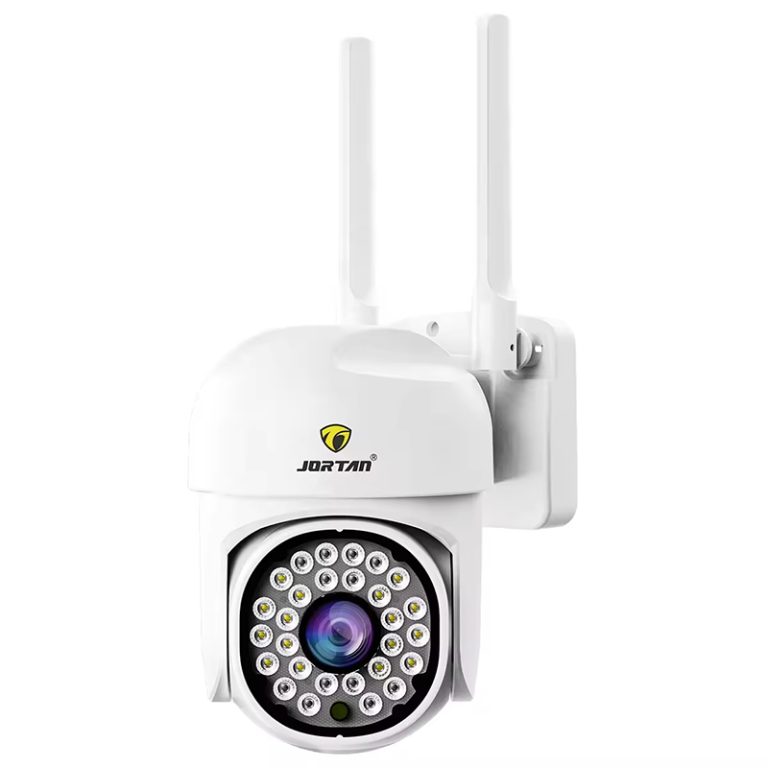
Jortan6 shows this idea clearly: it supports full-color mode, infrared mode, and intelligent alarm mode, plus 2D/3D noise reduction, digital wide dynamic, and H.265 video compression.
Infrared Is Still the Quiet Workhorse
Infrared night vision is the old reliable option. It gives a low-visibility black-and-white image and avoids the complaint that white light is too obvious or too bright for neighbors. Infrared helps when the buyer cares more about stable recording than color detail. A warehouse lane, a rear gate, or a side entrance may not need full-color proof every minute.
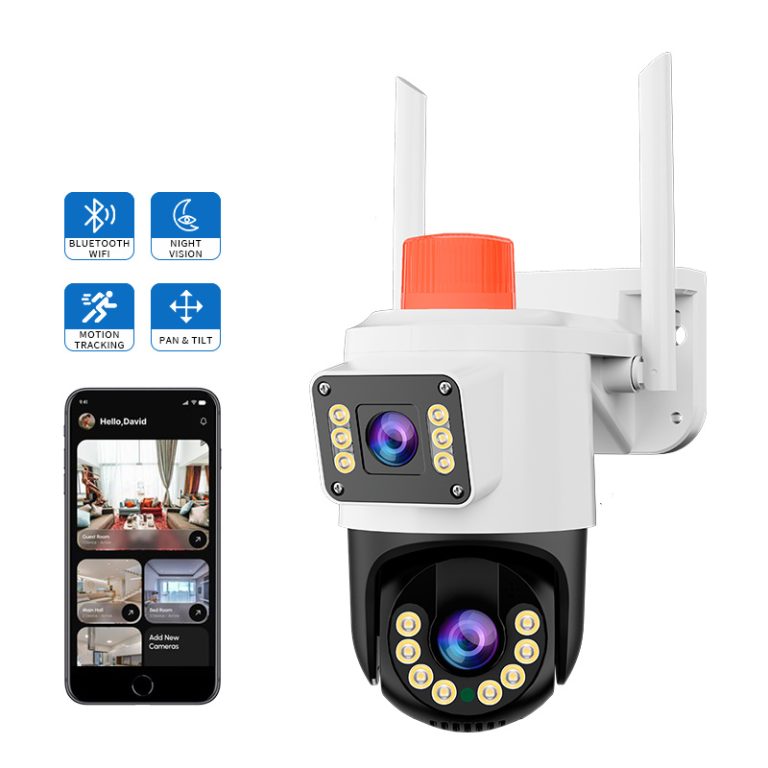
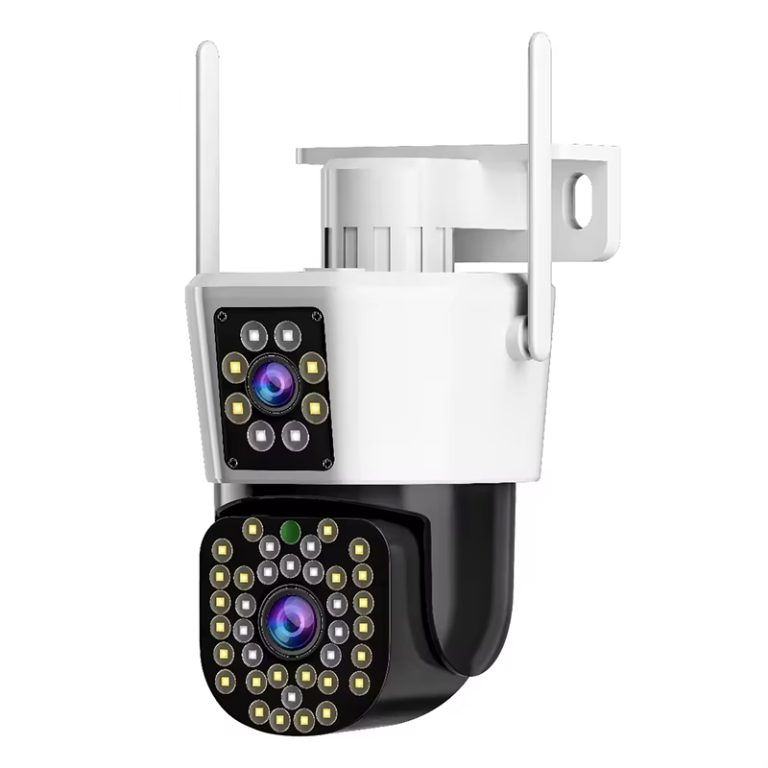
Jortan’s JT-9687PRO is a good example here because it combines 4MP resolution, color night vision, human motion tracking, two-way audio, 30-50m IR night vision, and IP66 weatherproofing.
Full Color Tries to Preserve the Scene, Not Only the Target
Full color is the mode buyers choose when night detail matters. Clothing color, car color, package color, and small scene details are easier to read in full color than in infrared black and white.
Full color asks for more from the site. Light placement, angle, and background reflection matter more, and a camera that looks strong in a showroom may become too bright or too sensitive once it faces a reflective wall or a narrow doorway.
Where the Tradeoffs Show Up in Projects
The biggest difference is not brightness. It is how the project feels after installation. Full color gives more proof, but it can create more visible light at night. Infrared is quieter, but it may leave the distributor explaining why the scene is black and white. Smart mode sits between them when the site changes from one hour to the next.
Night mode also affects camera storage, even when buyers do not say it that way. A camera storage plan that works for a single home entrance may not work for a warehouse with several cameras and long playback demand. A cloud storage camera is attractive when the end user wants quick phone access, while HDD-based NVR recording fits longer retention and several channels.
That is why the mode question should always be tied to the evidence question. If the project wants a stronger face read at night, full color or smart mode may justify the extra power and light. If the project mainly wants quiet monitoring, infrared may be the safer sell.
Which B2B Projects Usually Fit Each Mode
Retail Shops and Homes
Retail channels and home buyers usually ask for easy explanations and results they can understand quickly. Smart mode works well when the camera needs to adapt without much user input. Full color is a good fit when the customer wants to recognize colors, doors, and movement clearly at night.
Warehouses, Parking Areas, and Outdoor Gates
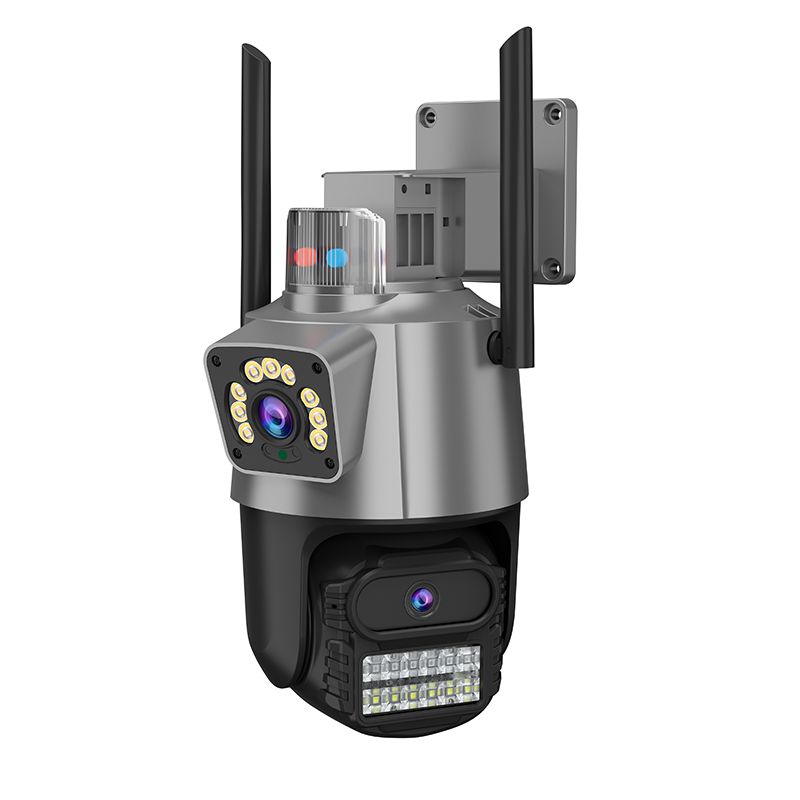
Infrared is still the safest starting point for many outdoor jobs because it is less visible and more predictable. A warehouse edge, a parking lane, or a side gate often needs a calm night setup rather than a flashy one. Jortan’s JT-9687PRO fits this style well because its 30-50m IR night vision and IP66 body make the project easier to defend.
If the buyer wants more detail for faces or vehicles, the project may move toward smart mode or full color. But that change can affect lighting, power draw, and how often the footage is reviewed later.
Brands and Distributors Building a Mixed Line
Most B2B sellers eventually need all three modes in one catalog. A single market rarely wants the same night behavior everywhere. One dealer may sell into retail and home channels. Another may focus on logistics yards. A third may want a higher-feature SKU for private labels.
For private-label buyers, the real question is whether the supplier can keep the story clean. OEM/ODM camera customization should cover the logo, packaging, app-related naming, and how the mode is described in the manual. If the box says one thing and the app or hardware does another, the support cost grows fast.
What Buyers Should Test Before Bulk Orders
Match the Sample to the Real Site
A sample should be tested at the actual installation height, not only on a showroom shelf. Buyers should check dusk, midnight, rain, backlight, reflection, and the angle where people or vehicles really move. The same mode can look excellent in one direction and weak in another.
Check App Behavior and Recording Plan
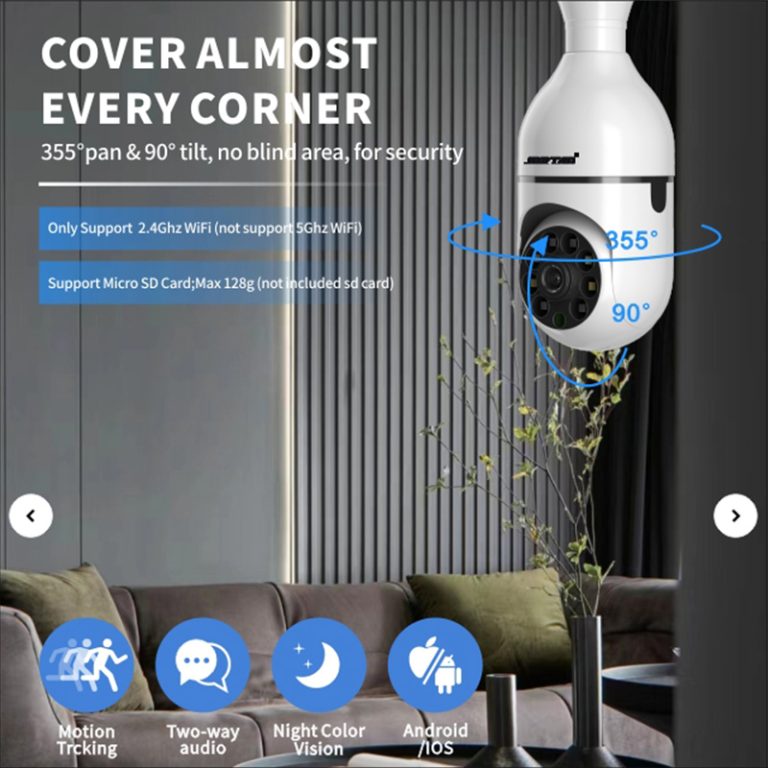
The camera needs to work with the app, the push alert logic, and the recording path. If the buyer wants local TF card storage, cloud storage backup, or an HDD/NVR setup, the mode choice should not break that plan. Jortan products often combine mobile monitoring on iOS and Android, ONVIF support, cloud technologies, and local storage options.
Confirm the Supplier Can Keep the Configuration Stable
Before a bulk order, buyers should confirm whether the same mode logic, light board, app version, packaging, and accessories will stay consistent in repeat orders. A small change in the light board or alarm logic can turn a clean product into a support headache.
If more details about samples, OEM/ODM planning, packaging, or project-specific mode combinations are needed, it is better tocontact Jortan with the target market, installation scene, and expected order size already listed.
FAQ
Q1: Is full color always better than infrared?
A1: No. Full color gives more scene detail, but infrared is often quieter, easier to live with, and more stable in outdoor projects where visible light is not welcome.
Q2: When should buyers choose smart mode cameras?
A2: Smart mode is a good fit when the project needs flexibility, mixed lighting behavior, and less hand-holding from the end user after installation.
Q3: Which projects are best for infrared cameras?
A3: Warehouses, parking areas, outdoor gates, and other sites that need low-visibility night monitoring are usually the safest infrared projects.
Q4: Can Jortan support different night vision modes for distributors?
A4: Yes. Jortan can support smart mode, infrared, and full-color product lines, together with OEM/ODM packaging, app-related options, and bulk-order communication for distributors.