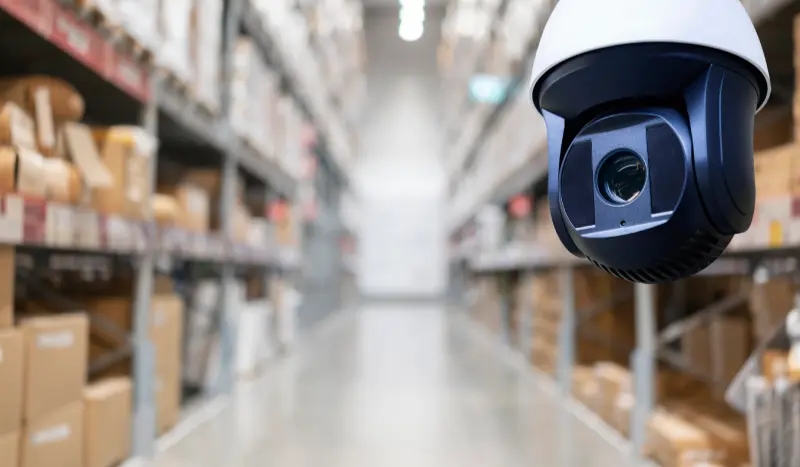
A warehouse rarely has one surveillance problem. A receiving dock deals with headlights and open gates, while a high-rack aisle needs a different view, a different focal length, and sometimes more detail on labels. Outdoor yards add rain, dust, and long cable runs.
A Warehouse Has Several Surveillance Zones, Not One
Loading docks, gates, and vehicle routes
Loading areas change quickly. Sunlight can enter through a door, a truck can point bright headlights toward the lens, and a person may cross the frame while the background remains dark. Wide dynamic range, sensible exposure control, IR-CUT day and night switching, and a useful night distance matter more here than a high pixel count on its own.
The mounting angle is equally important. A camera placed too high may show the top of a vehicle but lose useful facial detail. A camera aimed directly at a bright gate can produce washed-out areas and make the first few meters of the scene hard to read. A sample should be tested with the same gate position, lighting, and vehicle movement expected after installation.
Aisles, racks, and indoor storage areas
Indoor storage zones usually need coverage that stays readable between racks. The correct lens depends on aisle width, camera height, and the distance to a person or carton. Very wide coverage can make a far-end label too small, while a narrow view can leave the next aisle outside the frame. Resolution, focal length, and playback zoom should be considered together.
Motion-triggered recording can be useful in storage rooms where activity is occasional. It reduces unnecessary footage, but the trigger area and delay need testing. A delay that is too short may miss the person entering or leaving; a trigger that is too sensitive can fill the NVR with empty aisle footage.
Cold rooms, yards, and hard-to-reach points
Cold storage and outdoor yards add conditions that are easy to miss during a showroom test. Housing protection, cable sealing, bracket strength, condensation, dust, and temperature changes all affect service calls. IP66 or IP67 protection is useful for exposed locations, but the connector, tail cable, and installation method still need to be treated correctly.
Network access also changes by zone. PoE is practical where a cable route already exists. WiFi can help in a warehouse where reaching a remote point with both data and power is difficult, but distance, metal racks, and interference must be checked on-site. A wireless camera that performs well in an open office may lose stability behind dense shelving.
What a Warehouse Camera Line Must Handle
Coverage and image detail
A useful line normally includes more than one viewing role: a fixed camera for aisle coverage, a model suited to a dock or gate, and an option for a yard or longer viewing distance. The buyer should map each role to a target distance before selecting resolution. Text on a box, a person at a door, and a vehicle at a gate do not require the same image design.
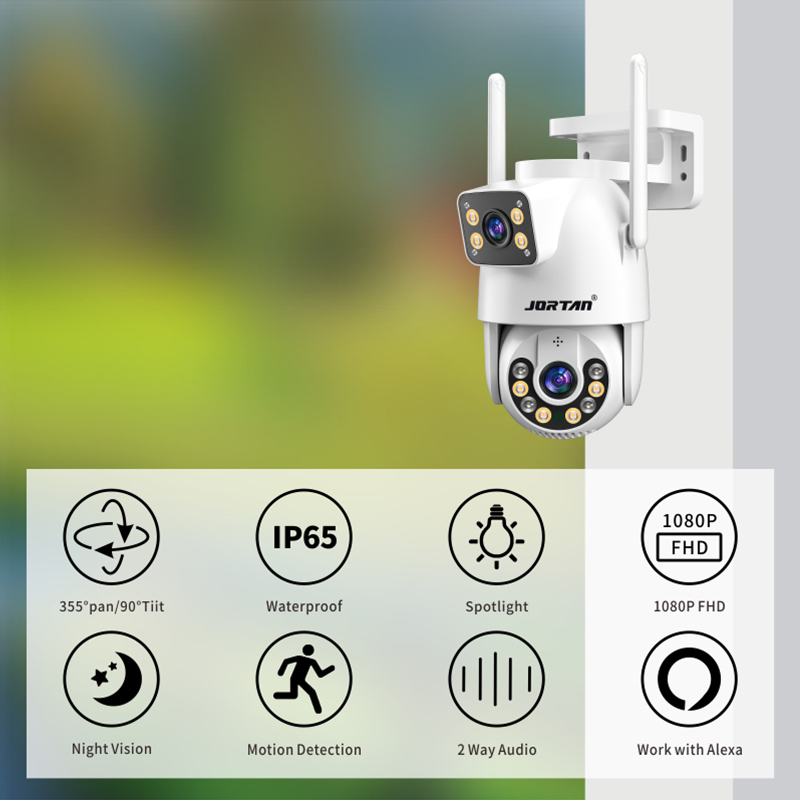
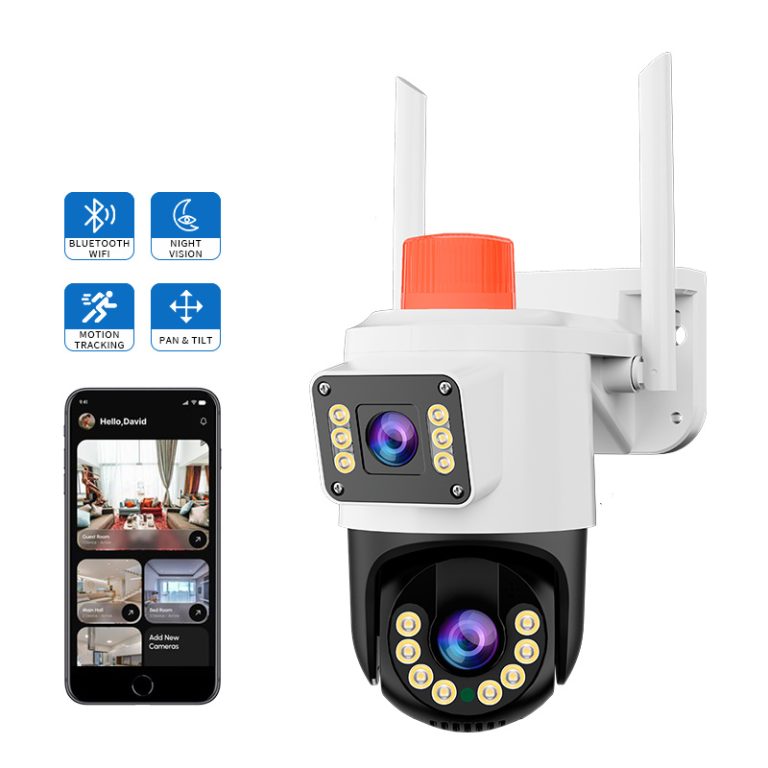
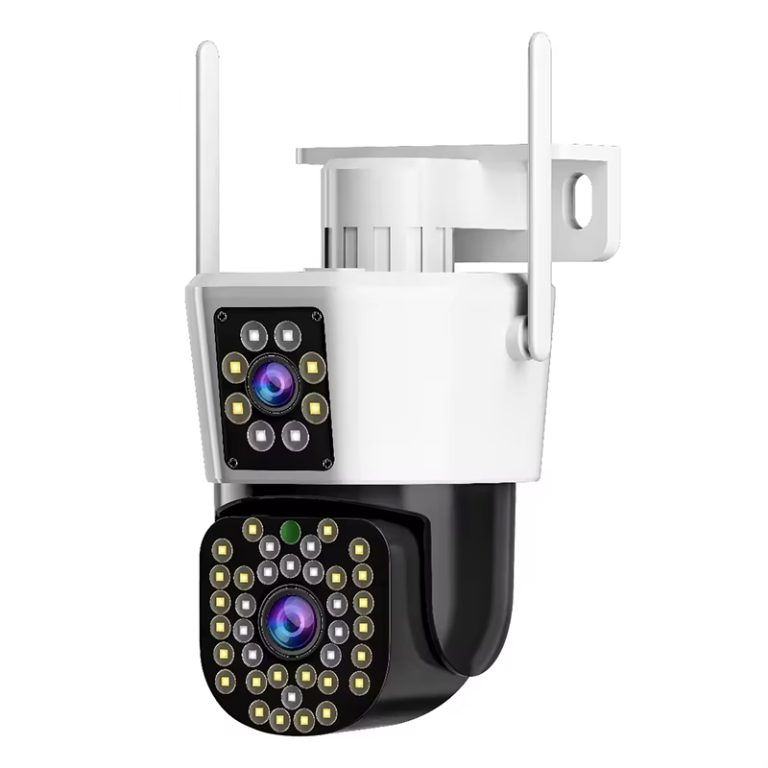
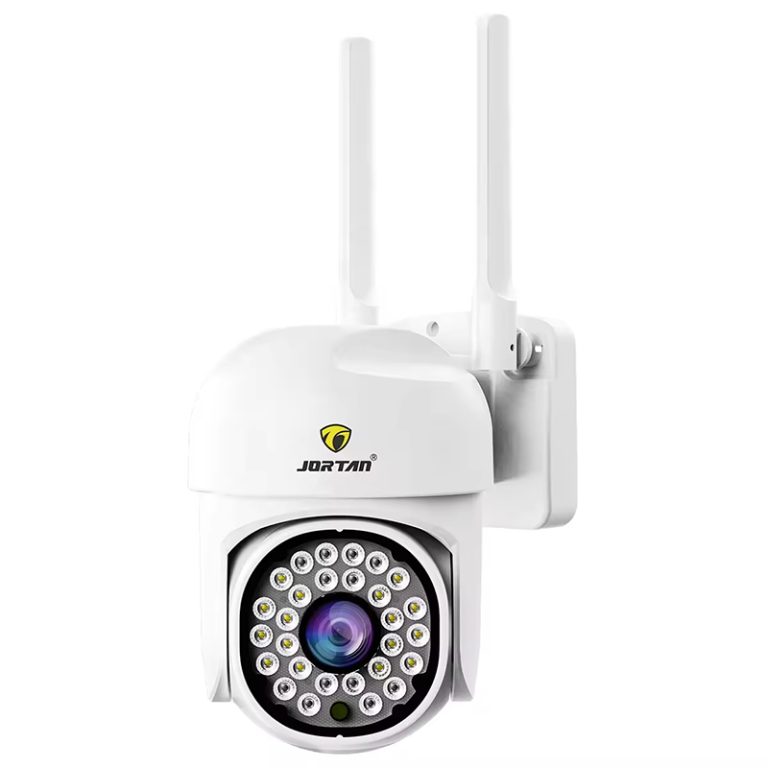
Jortan’s JT-9697QJ dual-lens camera can be used as a 4MP, H.265, and IP66 example when a project needs more than one viewing direction in a protected outdoor or semi-outdoor area. Its published 355-degree pan, 90-degree tilt, and approximately 30 m infrared distance are relevant points for a gate or yard discussion, while the final mounting height and target distance still need a site test.
Night monitoring and difficult lighting
Night performance is a chain of details. Infrared light, IR-CUT switching, lens position, nearby reflective surfaces, and exposure control all affect the final image. Too much infrared in a narrow space can create a pale or overexposed picture. A shiny floor, plastic curtain, or vehicle surface can also reflect light back toward the lens.
Buyers should test the exact night scene rather than rely on a stated infrared distance. Check faces at the door, labels near the dock, and movement across the frame. If a product line includes white-light or full-color models, confirm whether the added illumination is acceptable for workers, neighbors, and local site rules.
Network, storage, and management
Warehouse systems often grow after the first installation. The NVR or VMS should have enough incoming bandwidth for the planned camera count, with room for live view, playback, and remote users. H.265 can reduce transmission and storage pressure, but the camera, recorder, APP, and third-party software must support the same codec in practice.
A product line should also account for event search, alarm linkage, user permissions, and remote maintenance. If a manager cannot find the loading event quickly, the system has lost much of its value. If a firmware change breaks APP playback, the distributor inherits the support call even when the camera hardware is working.
Match the Line to Warehouse Buying Scenarios
For a small indoor warehouse, a fixed camera with stable APP access, suitable lens coverage, and reliable NVR recording may be enough. A distributor can keep the SKU count tight and offer a simple package with a camera, recorder, power, bracket, and network accessories.
For a larger facility, the line needs more separation. Indoor aisle models can cover racks, a dual-lens or pan-and-tilt option can support loading areas, and an IP66 outdoor model can serve the yard.
Where installation conditions differ by region, a private-label buyer may need the same housing with different default settings, APP language, packaging, or accessory kits. In that case, Jortan OEM/ODM camera service should be discussed through a written sample specification. The important point is repeatability: the approved lens, firmware, mounting parts, and carton contents must remain consistent in mass production.
How Distributors Should Build a Warehouse-Focused Product Line
Start with zones, not with a long model list. Define a core indoor SKU, a dock or yard SKU, and a network option for difficult points. Add higher-detail or longer-distance models only when a real customer scenario supports them. This keeps inventory easier to explain and reduces the risk of offering a camera that cannot meet the installation distance.
Sample testing should cover daytime, night, headlights, reflective floors, moving forklifts, WiFi distance, NVR playback, and power recovery. Record the firmware version, default stream settings, APP behavior, and bracket type. A sample that works only after an installer changes several hidden settings is not a stable product-line reference.
MOQ, lead time, packaging, and spare parts also belong in the decision. Missing waterproof connectors or the wrong mounting screw can stop a site team for a day. A changed APP version can create distributor complaints across an entire batch. Before placing a bulk order, contact Jortan with the warehouse layout, camera count, storage target, network method, and expected accessory list so the configuration can be checked against the real project.
The Jortan camera range can cover different warehouse roles, but the practical decision should still come from samples, site conditions, and production details. A product line fits warehouse needs when each SKU has a clear job, the installation team can deploy it without surprises, and the supplier can reproduce the approved setup.
FAQ
Q1: What camera should be stocked first for warehouse projects?
A1: A stable fixed indoor model for aisles and storage areas is usually the starting point. Add dock, yard, and difficult-network options as customer layouts require them.
Q2: Is higher resolution enough for reading warehouse labels?
A2: No. Target distance, lens focal length, lighting, installation angle, frame rate, and playback zoom all affect whether a label can be identified.
Q3: What should buyers test before a warehouse camera bulk order?
A3: Test day and night images, headlights, infrared reflection, NVR recording, APP playback, network stability, mounting accessories, and sample-to-batch configuration consistency.