Why are outdoor IP cameras no longer simple “recording devices”?
Outdoor IP cameras have shifted from passive recording tools to intelligent security nodes that integrate optical imaging, edge computing, AI detection, cloud connectivity, and real-time interaction. You are no longer selecting a device that merely “captures footage”, but a frontline system that decides when to alert you, how accurately it interprets human behavior, and how reliably it performs under unpredictable outdoor conditions.
The modern security camera industry itself reflects this shift. What once revolved around lenses and encoders now operates as a composite ecosystem combining artificial intelligence, Internet of Things architecture, and smart terminals capable of remote interaction and cloud communication.
This means every technical decision, including sensor type, AI model, compression method, storage logic, and power stability, directly shapes whether your system prevents incidents or merely documents them after the fact.
Who is Jortan, and why does its outdoor camera design philosophy matter to your selection?
Zhejiang Jortan Electronic Technology Co., Ltd. operates as an integrated manufacturer combining R&D, production, design, and service under one system, supported by a more than 30,000 square meters facility and standardized production processes. This scale matters because consistency in optical calibration, PCB stability, enclosure tolerance, and long-term reliability cannot be achieved without industrial discipline.
Instead of treating outdoor cameras as single-purpose gadgets, Jortan’s architecture aligns with a system-oriented approach—lightning protection compliant with national and international standards, AI-based video compression for bandwidth efficiency, ONVIF compatibility for platform flexibility, and cloud/mobile integration for continuous access. These choices reflect a practical understanding of real deployment conditions, such as unstable power grids, inconsistent Wi-Fi environments, and the need for long-term scalability.
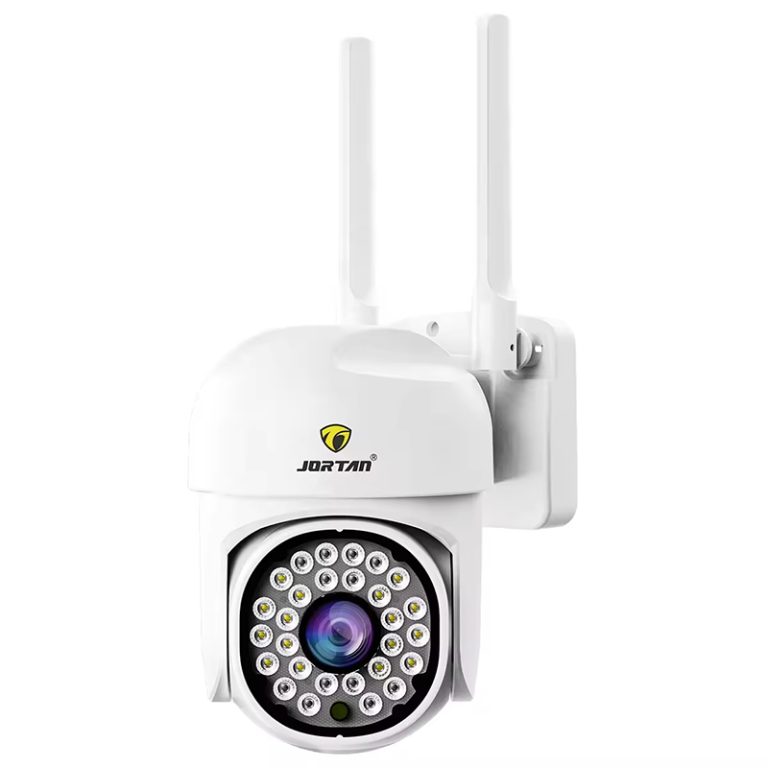
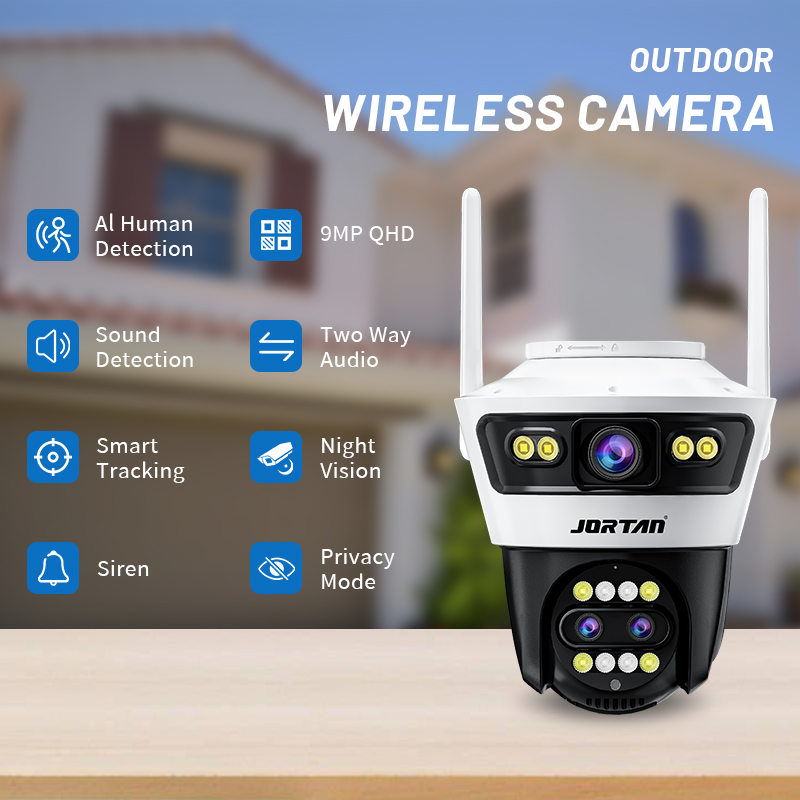
This design philosophy becomes visible when you look at devices such as the Jortan 5 smart outdoor IP camera. Rather than focusing only on resolution claims, its structure emphasizes AI detection logic, night-mode adaptability, storage redundancy, and operational resilience, which are critical factors when you expect your system to function autonomously instead of requiring constant intervention.
What environmental risks must your outdoor IP camera tolerate?
Outdoor deployment fails first at the physical layer. Before evaluating algorithms or interfaces, you need confidence that the device remains stable in heat, rain, dust, and electrical fluctuation.
Weather resistance and enclosure design
A professional-grade outdoor camera should maintain IP66-level protection against water ingress and dust contamination. Dome and PTZ designs ensure that properly sealed housings allow long-term indoor or outdoor use without condensation damage.
This is not cosmetic engineering. Dust infiltration gradually degrades IR performance, moisture destabilizes power circuits, and poor sealing shortens sensor lifespan.
Power stability and lightning protection
Power instability is one of the most common real-world failure points. Devices that comply with lightning protection standards such as GB/T17626.5 and IEC61000-4-5 demonstrate higher resilience to surge events.
If your camera reboots during storms or fluctuates during night-mode activation, detection logic becomes irrelevant. Stable power design is not optional for outdoor security, but essential.
How do resolution and lens structure affect real security outcomes?
High pixel counts alone do not guarantee usable evidence. What matters is how optics, sensor sensitivity, and lens architecture interact with environmental light and distance.
Sensor size, real resolution, and low-light thresholds
Advanced outdoor cameras increasingly rely on sensors capable of maintaining color integrity at illumination levels as low as 0.01 lux. Technical specifications show that modern CMOS sensors paired with optimized ISP processing can preserve visibility even when environmental light approaches near darkness, which determines whether faces remain identifiable rather than becoming blurred silhouettes.
Single-lens vs dual-lens vs PTZ combinations
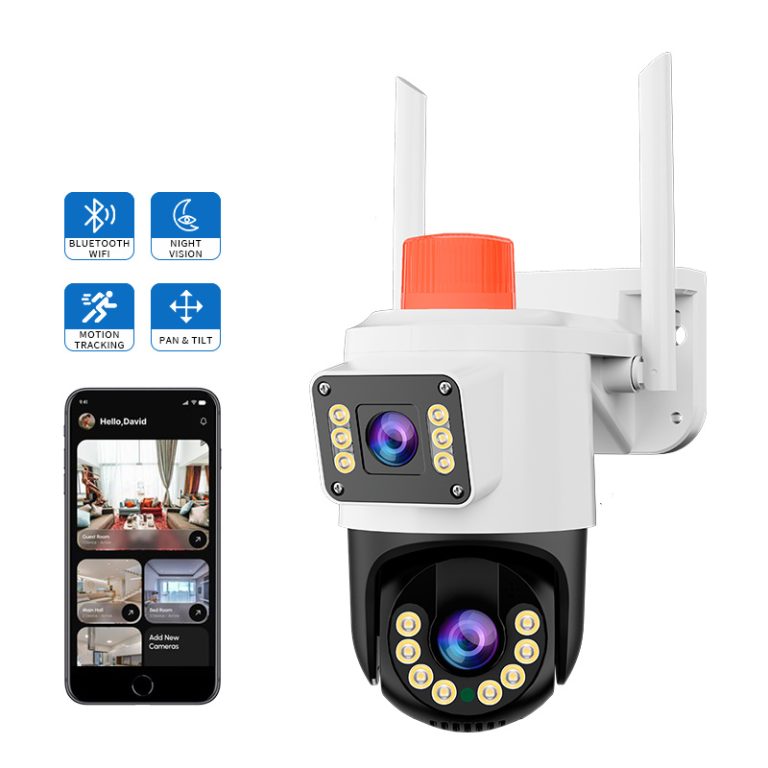
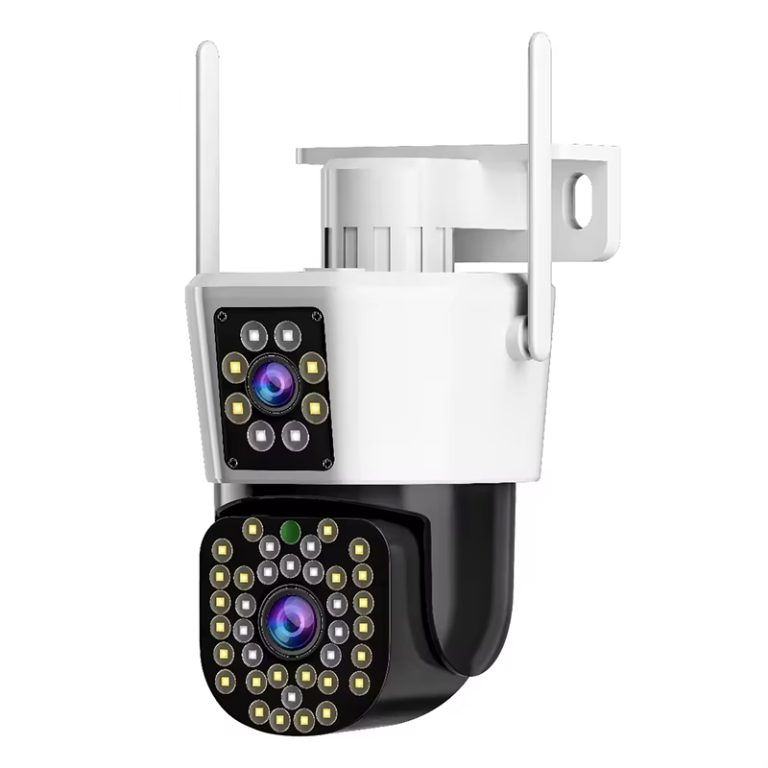
Dual-lens architecture introduces structural advantages: wide-angle context from one lens and telephoto detail from another. This is not redundancy but functional segmentation. The dual-screen monitoring logic demonstrates how panoramic and zoomed views can coexist simultaneously rather than forcing you to choose between them, significantly reducing blind spots and improving situational awareness without multiplying device count.
Why does night vision mode selection change intrusion detection accuracy?
Night performance defines whether your system actively protects or passively records.
Infrared, white-light, and smart hybrid night modes
Modern cameras typically support three night modes: infrared black-and-white, scheduled full-color, and intelligent adaptive switching. In intelligent mode, the device operates in infrared until motion appears, then automatically activates full-color lighting for detailed capture. This matters because permanent white-light illumination can cause neighbor complaints, while pure infrared can sacrifice color evidence.
Detection distance vs illumination balance
Full-color night vision extending to approximately 50 meters provides strong coverage for yards, parking zones, and entry paths.
However, excessive illumination without intelligent control can degrade image clarity through reflection and overexposure. Effective night systems balance light output with algorithmic switching rather than brute brightness.
How important is AI detection compared with traditional motion alerts?
Motion detection based purely on pixel change produces high false-alarm rates. AI-based shape recognition shifts detection from “movement” to “meaning.”
Human-shape detection and multi-target tracking
Human-shaped models support recognition distances up to 15 meters and multi-target tracking, which means that fewer alerts are caused by tree shadows, insects, or passing headlights, and more reliable notifications when actual human presence appears.
Auto-tracking and evidence capture
AI tracking further enhances forensic value. Automatic zoom tracking allows the camera to follow a subject’s trajectory while dynamically adjusting focal distance, preserving critical visual evidence rather than losing detail when a person moves across the frame. This capability bridges the gap between passive surveillance and active scene interpretation.
How should storage architecture influence your camera choice?
Without reliable storage logic, even the most advanced camera becomes little more than a live viewer.
Local SD card vs cloud storage redundancy
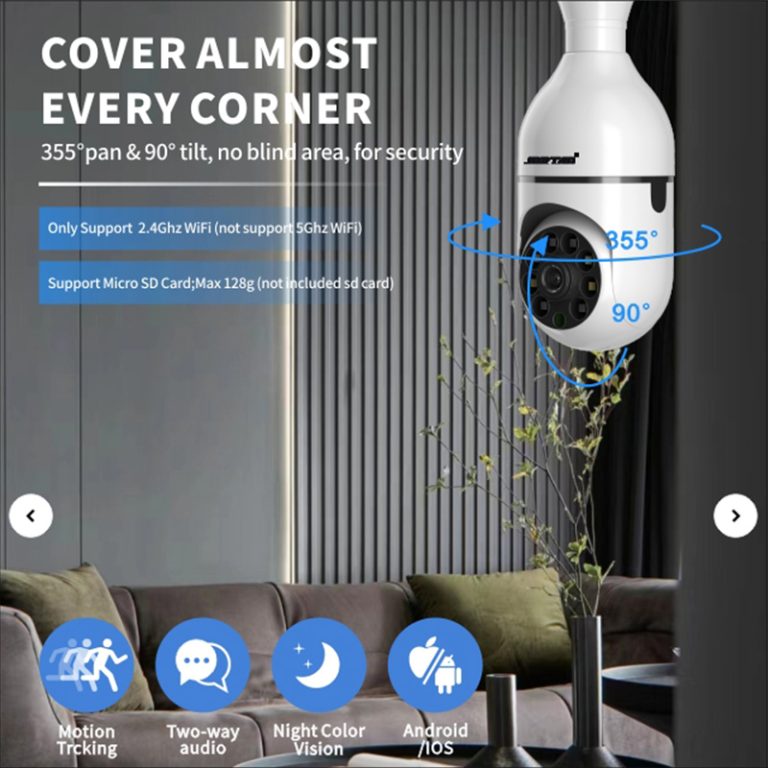
Most modern systems support TF card storage up to 128GB alongside cloud storage options.
Local storage ensures independence from connectivity failures, and cloud storage protects against physical damage or theft of the device itself. The combination creates redundancy rather than reliance.
Network independence via AP hotspot mode
Some models integrate an internal AP hotspot that allows direct phone-to-camera connection without external network access, provided devices remain within approximately 20 meters. This capability matters in temporary outages or during initial setup when the infrastructure is incomplete.
What installation and control factors reduce long-term maintenance costs?
The more complex your environment, the more critical deployment logic becomes.
Wired vs Wi-Fi vs 4G outdoor setups
Wireless cameras divide into Wi-Fi and 4G transmission categories. Wi-Fi offers convenience within networked homes, while 4G transmission enables remote locations without fixed connectivity. The choice should align with signal stability rather than installation simplicity alone.
Mobile app, multi-user sharing, and desktop monitoring
Professional-grade usability includes LAN multi-screen viewing on PC and controlled multi-user sharing, where only administrators can authorize access, which reduces operational friction without compromising access control.
When does a dual-camera outdoor system outperform a traditional single-lens design?
As coverage demands grow, efficiency becomes architectural rather than numerical.
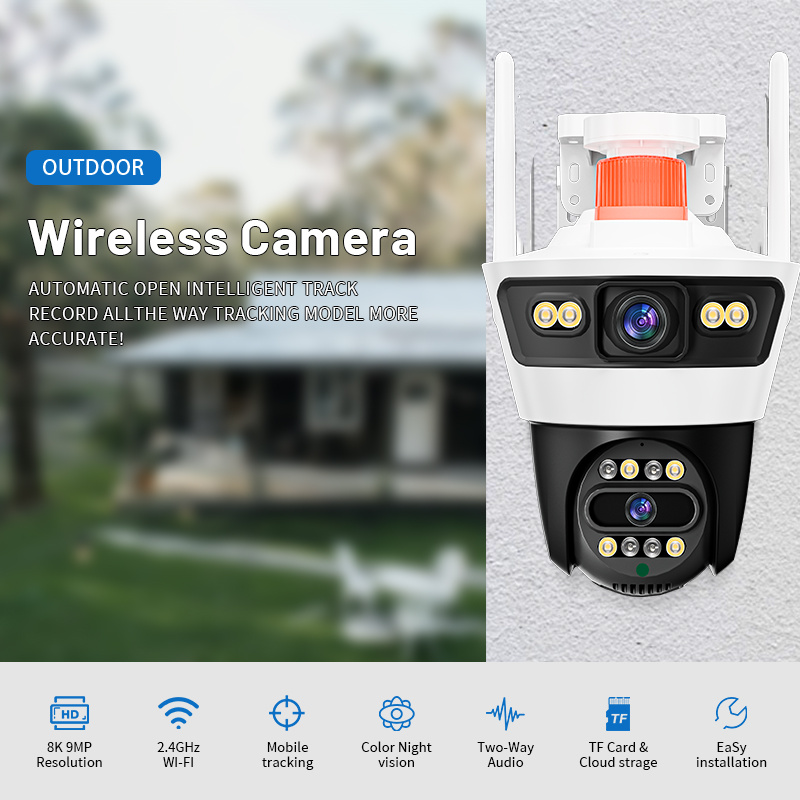
Dual-lens PTZ structures allow one fixed lens to maintain continuous wide-area context while the secondary lens dynamically tracks movement. In real deployments, such as driveways, gardens, and warehouse exteriors, this approach delivers superior coverage without doubling installation points. Devices such as the Jortan 4 AI smart outdoor IP camera illustrate this logic through synchronized monitoring and dual-screen architecture rather than mere hardware stacking.
Fixed + PTZ synchronized monitoring
The dual-monitoring mechanism supports simultaneous viewpoints, preserving global awareness while tracking local detail. This structure mirrors professional surveillance layouts but compresses them into a single unit.
Cost efficiency vs coverage expansion
One device functioning as two cameras reduces wiring complexity, maintenance effort, and blind-zone risk. The result is not simply economic efficiency, but architectural clarity—fewer devices, higher functional density, stronger coverage continuity.
How to build a camera system that acts before incidents escalate
If your goal is meaningful security rather than symbolic monitoring, your selection criteria must reflect system behavior rather than isolated features.
A well-chosen outdoor IP camera does not wait for you to review footage. It interprets scenes, adapts to light, maintains stability under stress, and communicates precisely when action matters. When each component aligns with this logic, your system becomes preventative infrastructure rather than reactive documentation.
FAQs
Q: Is higher resolution always better for outdoor security cameras?
A: Not necessarily. Sensor sensitivity, lens quality, and night performance often influence real-world clarity more than pixel count alone. A balanced optical system produces more usable evidence than extreme resolution paired with weak low-light behavior.
Q: Should you rely only on cloud storage for outdoor monitoring?
A: No. Cloud storage provides redundancy, but local storage ensures continuity during connectivity disruptions. A dual-storage approach protects both accessibility and resilience.
Q: Does AI human detection significantly reduce false alarms outdoors?
A: Yes. Shape-based AI filters environmental noise such as rain, insects, and vegetation movement far more effectively than traditional motion detection, improving trust in alert systems.