
Why is selecting an NVR IP camera system a system engineering decision rather than a product purchase?
When you deploy an IP surveillance system, the NVR is not just a recorder, but becomes the traffic coordinator, storage engine, decoding platform, and stability anchor for the entire architecture. Just relying on the image quality of cameras does not determine whether footage remains continuous during peak hours, AI analysis works reliably, or historical evidence can be retrieved months later without corruption.
In real projects, many failures originate from a mismatched system design. For example, too many high-bitrate cameras on a low-throughput NVR, PoE ports that collapse under startup current, or storage subsystems that fragment under sustained write pressure. These problems rarely appear in instructions, but directly determine operational reliability.
Choosing an NVR system is, therefore, closer to capacity planning and risk control than to shopping for hardware. You are designing a data pipeline that must remain stable under changing lighting conditions, fluctuating traffic, and years of continuous operation.
Who is Jortan, and why does its NVR-centric design philosophy reflect real deployment environments?
Zhejiang Jortan Electronic Technology Co., Ltd. is a vertically integrated manufacturer covering product design, production, testing, and after-sales service. We manage more than 30,000 square meters of production space and maintain in-house engineering teams responsible for hardware architecture, firmware design, and system validation. Our product portfolio includes IP cameras, PTZ cameras, wireless and 4G models, as well as NVR platforms designed for small to mid-scale commercial and institutional deployments.
From a professional perspective, cameras have evolved from simple video capture devices into networked smart terminals integrated with AI detection, mobile access, and cloud platforms.
Modern surveillance systems increasingly rely on coordinated operation between edge devices and recording servers rather than isolated components. Design choices in our ecosystem reflect these realities. For example, our products support H.265/H.265AI compression to control bandwidth, and adopt ONVIF compatibility for third-party integration and hybrid local-and-cloud storage strategies.
Instead of assuming ideal network conditions, our NVR products are structured to tolerate unstable links, variable camera bitrates, and continuous write workloads. This system-level approach is more relevant to long-term surveillance operations than focusing on camera resolution alone.
What role does the NVR play in an IP surveillance system?
Why the NVR is a traffic controller, storage engine, and system stability anchor rather than a passive recorder
In IP architectures, every camera sends compressed data streams into a shared network domain. The NVR must aggregate these flows, decode selected channels for preview, index metadata, and commit continuous writes to disk. However, in the process, there may be several potential problems.
Unlike analog DVRs, modern NVRs coordinate multiple subsystems simultaneously. They regulate uplink traffic, negotiate stream formats, manage user sessions, and enforce retention rules. Therefore, the system reliability depends more on the NVR’s internal design than on any single camera parameter.
How do camera quantity and resolution reshape NVR performance requirements?
Why channel count alone is misleading without bitrate, codec type, and frame structure analysis
A “4-channel NVR” label means little without context. Four 2 MP cameras at 15 fps using H.265 impose a different load from four 8 MP cameras at 30 fps using H.264.
The actual effective capacity is determined by:
- Average and peak bitrate per stream
- Codec efficiency (H.264 vs H.265 vs H.265AI)
- GOP structure and I-frame frequency
- Concurrent decoding sessions
When these factors exceed NVR throughput, the problems of delayed playback, frame skipping, or corrupted segments may occur even though nominal channel limits are not exceeded.
How important is PoE design when selecting an NVR system?
Why power budgeting, port isolation, and surge protection directly affect long-term system reliability
Integrated PoE simplifies wiring but concentrates electrical risk inside the NVR chassis. If the power design is poor, startup current from multiple cameras can collapse voltage rails, causing silent restarts or intermittent camera dropouts.
Well-designed systems can isolate ports, allocate sufficient wattage reserves, and integrate surge suppression. These factors hardly appear in marketing sheets but determine whether cameras remain online during storms, grid fluctuations, or seasonal temperature shifts.
How should storage architecture be evaluated in professional NVR systems?
Why disk interface type, write endurance strategy, and redundancy logic matter more than raw capacity
Continuous recording produces a write-intensive workload unlike office computing. Consumer-grade disks fragment quickly, increasing seek latency and raising failure probability.
So you should evaluate:
- Number of SATA channels
- Support for surveillance-grade HDDs
- Write caching policy
- Journal recovery mechanisms
- Optional mirroring or parallel write paths
Storage design defines how much data can be read after years of cyclic overwriting.
How does AI processing change NVR selection criteria?
Why human detection, object classification, and metadata indexing shift CPU and memory priorities
AI features introduce variable computational loads:
- If analysis occurs centrally, the NVR must allocate CPU cycles and memory for inference pipelines
- If analysis is performed at the edge, the NVR must still index metadata and manage event queries.
Either model requires additional processing headroom. Systems sized only for raw video recording often fail once intelligent detection is enabled.
How does a compact PoE NVR system serve small and mid-scale deployments?
Why does integrated PoE switching and simplified topology reduce installation risk in distributed locations
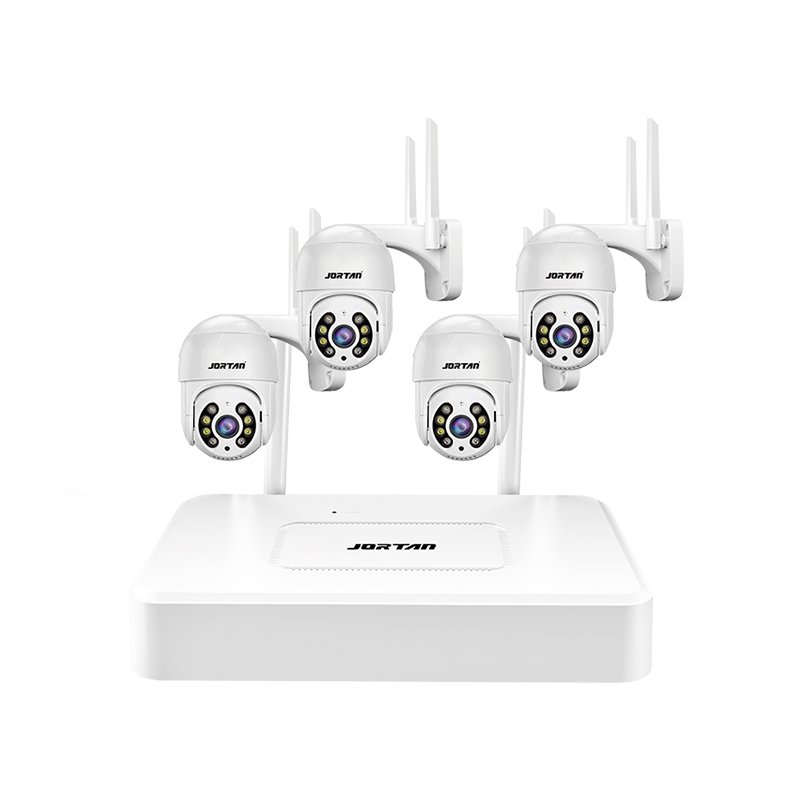
In retail chains, offices, clinics, and small warehouses, compact NVR platforms with integrated PoE reduce the number of external devices, cabling mistakes, and configuration steps.
A representative example is the JT-8276-4PXM NVR camera. Its integrated PoE ports allow cameras to connect directly without separate switches, lowering deployment complexity and reducing points of failure. For locations managed remotely, fewer devices also mean fewer variables during troubleshooting.
How do multi-disk NVR platforms support long-term evidence retention?
Why parallel storage channels and write balancing improve data integrity in high-activity environments
Large facilities generate sustained high-bitrate streams around the clock. Single-disk architectures often become bottlenecks as queues lengthen and fragmentation increases.
Platforms such as the 8906ZL3-4 NVR camera support multi-disk layouts to distribute writes and extend disk lifespan. Parallel channels allow higher sustained throughput and reduce the probability of total data loss when a single drive fails, which is essential for sites requiring months of retention.

How does network topology affect NVR system stability?
Why VLAN design, uplink capacity, and multicast behavior determine whether video streams remain predictable
Flat networks with unmanaged switches often suffer from broadcast storms and congestion. When uplink capacity is underestimated, cameras begin buffering aggressively, increasing latency and reducing frame accuracy. Segmenting surveillance traffic, reserving bandwidth, and controlling multicast propagation stabilizes NVR input rates and prevents cascading failures during peak usage.
How should remote access and cybersecurity influence your choice?
Why encryption, account hierarchy, and firmware update policy are operational necessities
Modern NVRs expose services to mobile apps, browsers, and third-party platforms. Without encrypted channels and role-based access, surveillance data becomes vulnerable.
Firmware maintenance policies also matter. Regular security updates close protocol vulnerabilities that could otherwise allow unauthorized access or data manipulation.
Does system scalability justify higher initial NVR investment?
Why future camera expansion costs more than early NVR oversizing
Replacing an undersized NVR later often forces downtime, reconfiguration, and data migration. Oversizing early allows you to add cameras, enable AI features, and increase retention periods without redesigning the system. This strategy typically reduces total ownership cost even if the initial expenditure is higher.
When is a lightweight NVR system the better choice?
How temporary projects, low-density layouts, and mobile deployments change the optimization logic
Construction sites, temporary events, or pilot installations may prioritize speed and portability over long retention when compact NVR units with limited channels can satisfy these scenarios efficiently, provided you accept reduced expansion capability.
Why the best NVR system is defined by architecture fit rather than specification tables
An NVR system succeeds when its internal design matches your data volume, network conditions, and operational horizon, instead of its channel numbers and storage size.
Stable surveillance depends on throughput balance, power design, disk endurance, processing headroom, and cybersecurity discipline. When these factors coordinate, cameras become reliable sensors instead of fragile endpoints.
FAQs
Q1: How many cameras should an NVR realistically support per CPU?
A: Capacity depends on bitrate, codec, and concurrent decoding tasks. Channel count alone does not represent real processing load.
Q2: Is integrated PoE always preferable to external switches?
A: For small to mid-scale systems, it simplifies deployment, but large installations may require dedicated switching layers for redundancy and power management.
Q3: Should AI processing be centralized in the NVR or distributed to cameras?
A: Hybrid models often work best, with basic filtering at the edge and structured analysis centrally to balance bandwidth and compute resources.